Fig 1
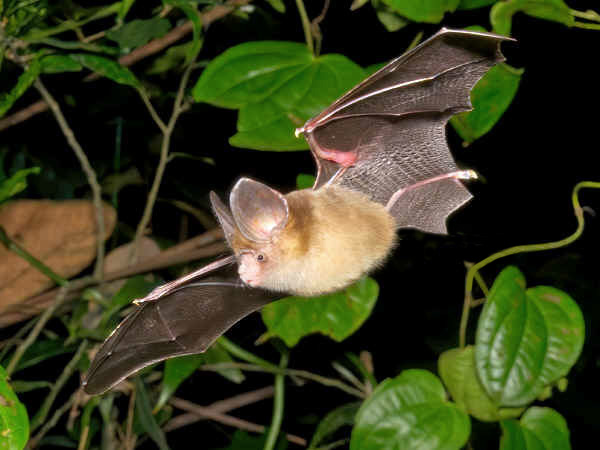
Fig 2
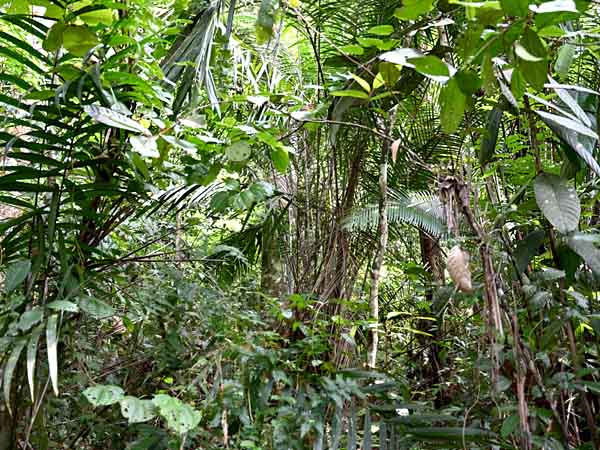
Fig 3
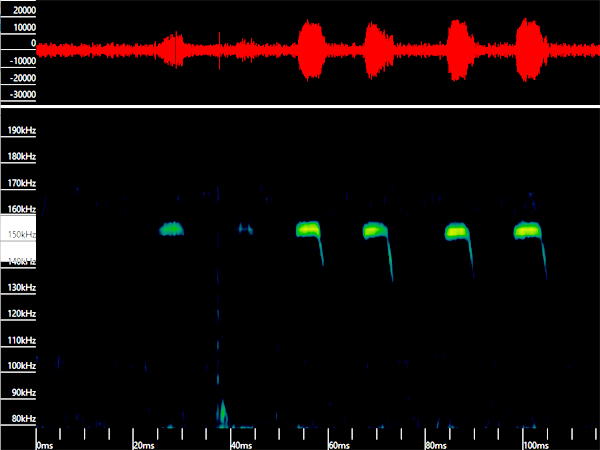
Fig 4
|
Order : CHIROPTERA
Family : Hipposideridae
Species : Hipposideros cf. cineraceus
Forearm Length : 3.3 to 4.2 cm
Weight : ~ 4.0 to 5.5 grams
Source : Francis (2019)
Francis (2019) suggested that at least two species of bat appear to be assigned to Hipposideros cf. cineraceus, with
the smaller, more
widespread form present in at least Peninsular Malaysia and Laos. This
smaller form has a
search-phase echolocation call of around 155 kHz.
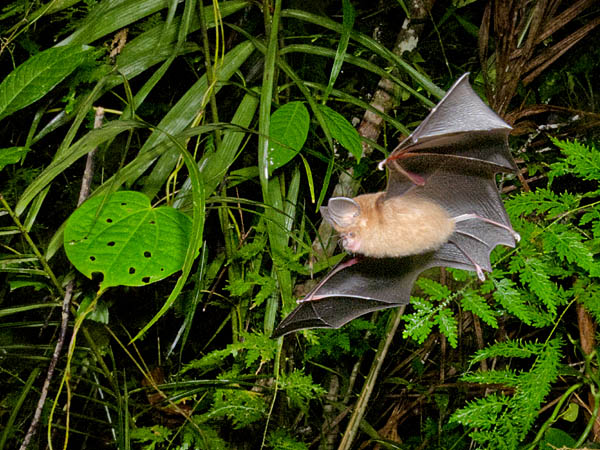
The images on this page are of a Hipposideros roundleaf
bat from Perak, Peninsular Malaysia. Two bats were photographed at dusk as
they emerged
from an area of logged, lowland primary forest; they were flying towards an
adjacent patch of secondary forest, presumably to forage for
insects.
These two bats are likely to be part of the Hipposideros cf. cineraceus
complex ('Ashy Roundleaf Bat'); the call frequency of the bat in Figure 2
was confirmed as 153.8 kHz.
The pelage of these bats fits the description of Hipposideros
cf. cineraceus in Francis (2019) i.e. 'upperparts
buffy-brown to greyish-brown, underparts pale brown to buffy-white'.
The ears are relatively large and rounded in shape, and
the noseleaf is simple with no lateral leaflets.
Hipposideros
cf. cineraceus is known to roost in caves and road culverts. The bats shown
here may be roosting in rock crevices/overhangs (as there are no limestone
caves in the vicinity), or possibly tree hollows (?).
Figs 1 and 2 : Probable Hipposideros cf. cineraceus from Perak, Peninsular Malaysia, photographed at the edge of logged, lowland primary forest, as
they
flew across a rural road into an area of degraded secondary forest.
Fig 3 : Densely cluttered habitat at the margin of primary lowland forest,
where higher levels of light promote rapid plant growth compared with the
forest interior. Numerous species of Hipposideros roundleaf bat may
inhabit the forest interior, but most rarely venture beyond its margins.
Fig 4 : Search-phase sonogram of the bat in Figure 2. The constant frequency
(CF) portion averages 153.8 kHz.
References :
Francis, C.M. 2019. A Field Guide to the Mammals of South-east Asia. Second
Edition. New Holland. 416 pp.
Wongwaiyut, P., Karapan, S., Saekong, P., Francis, C. M., Guillen-Servent,
A., Senawi, J., ... & Soisook, P. (2023). Solving the taxonomic identity
of Hipposideros cineraceus sensu lato (Chiroptera: Hipposideridae) in
the Thai-Malay Peninsula, with the description of a new species. Zootaxa,
5277(3), 401-442.
|