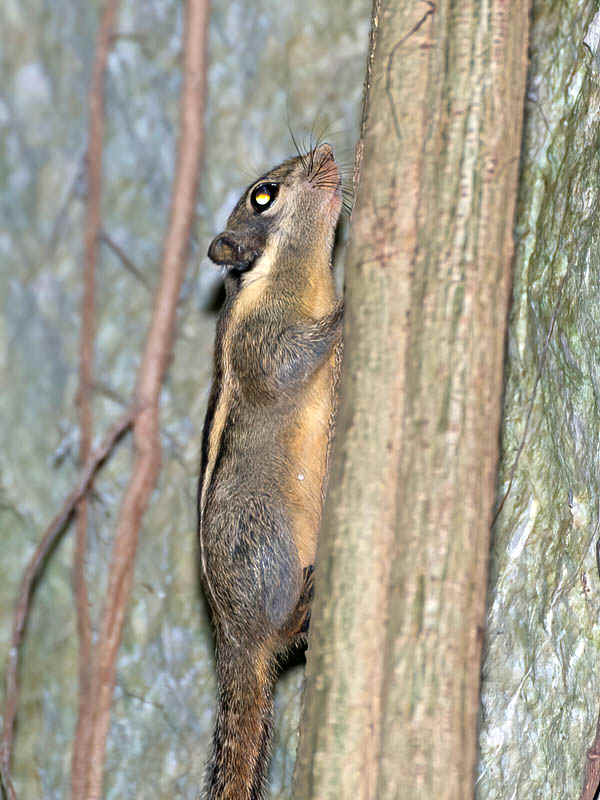
Fig 1
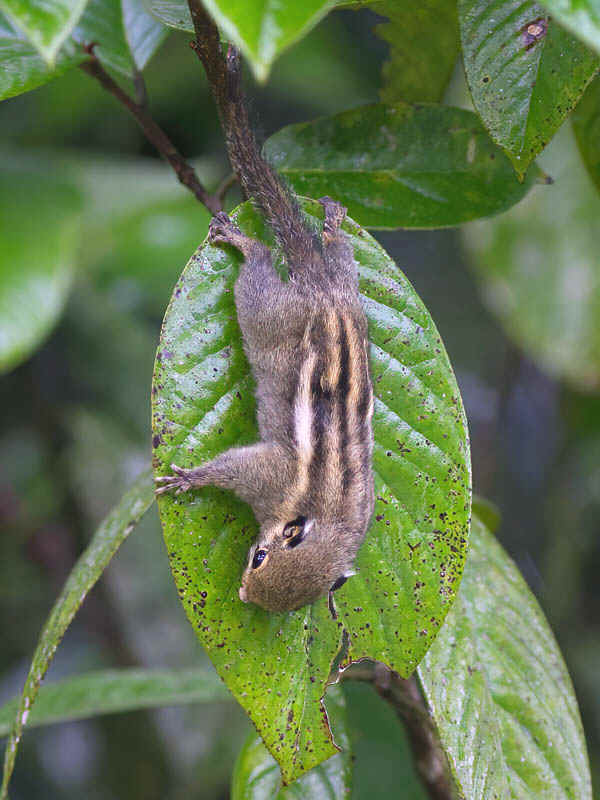
Fig 2
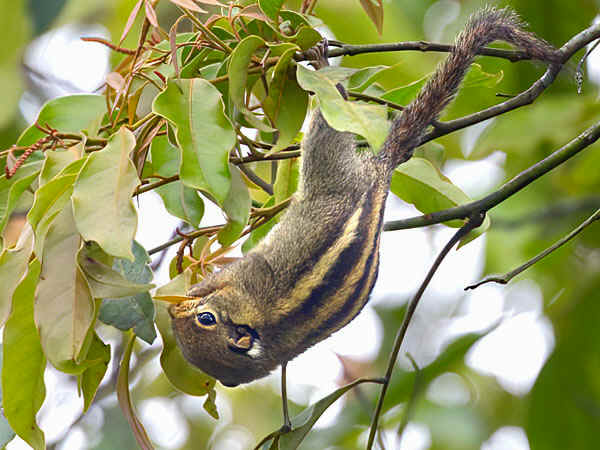
Fig 3
|
Order : RODENTIA
Family : Sciuridae
Species : Tamiops barbei
Head-Body Length : average 10-7-11.4 cm
Weight : 47 grams
Tail Length : 10.6-16.3 cm
(Hinckley et al, 2024) Tamiops
barbei (Southeast Asian Striped Squirrel) is
mainly a species of montane, forested areas above 700
metres elevation, however in some parts of Myanmar and Thailand it is known
to occur at lower elevations. In Krabi, southern Thailand, it occurs at sea
level in coastal, karst limestone habitat (Fig 1).
This small squirrel is almost exclusively arboreal in habits and rarely
comes to ground; it prefers tall trees, including fig trees and coconut palms.
Tamiops
barbei was formerly considered to be a subspecies of the Himalayan Striped Squirrel (Tamiops macclellandi)
but is now treated as a distinct species (Hinckley et al,
2024).
It is fast-moving, and can easily be overlooked as it frantically moves from tree to tree
searching for small fruits and insects. Its striped pattern is an effective camouflage on
rough, fissured tree trunks.
The thickness and length
of the alternating cream and dark brown dorsal stripes is a key
identifying feature, and is diagnostic in distinguishing it from other small
striped squirrels (refer to Hinckley et al, 2024, page 698).
This
species occurs in parts of eastern Myanmar, southern China, northwestern Vietnam,
Thailand (excluding eastern Thailand), and northern and central parts of Peninsular
Malaysia (Hinckley et al, 2024). In eastern Thailand it is replaced by Tamiops
rodolphii (Cambodian Striped Squirrel).
Fig 1 : Example climbing the aerial root of a fig tree in coastal, karst
limestone habitat in Krabi, southern Thailand.
Fig 2 : Example from lower montane
forest at Fraser's Hill, Peninsular
Malaysia.
Fig 3 : Consuming part of a fresh, new leaf at Fraser's Hill, Peninsular
Malaysia.
References :
Hinckley A, Maldonado JE, Tamura N, Leonard JA, Hawkins MTR (2024) Lost in
synonymy: Integrative species delimitation reveals two unrecognized species
of Southern Asian tree squirrels (Rodentia: Sciuridae: Callosciurinae).
Vertebrate Zoology 74 683–707.
|