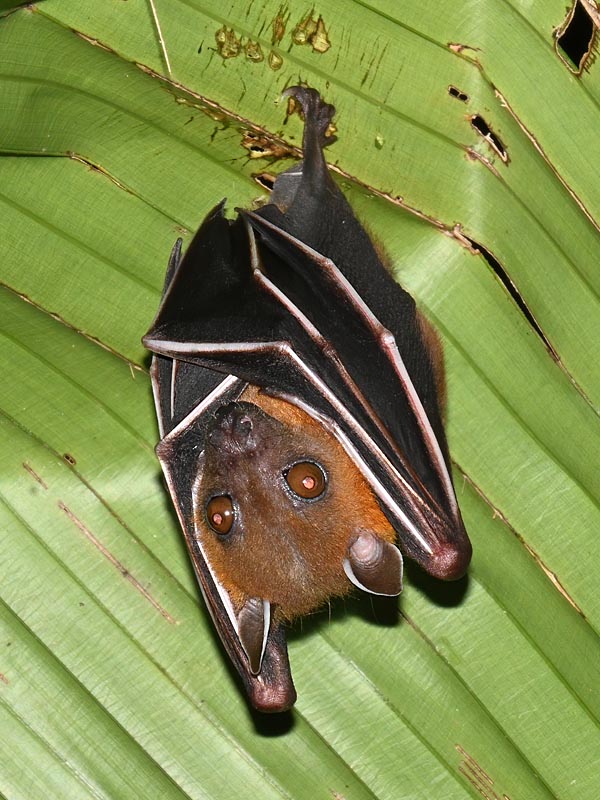
Fig 1
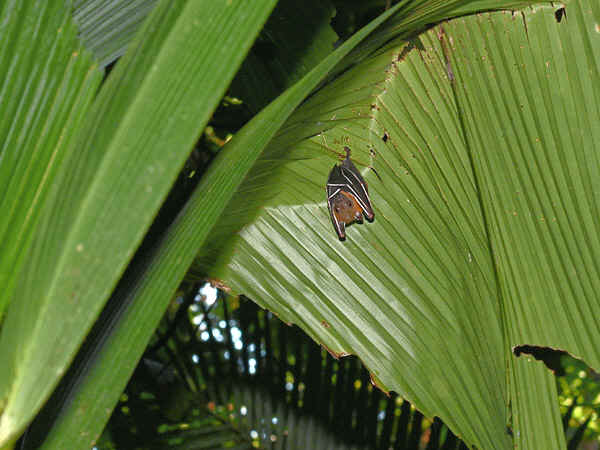
Fig 2
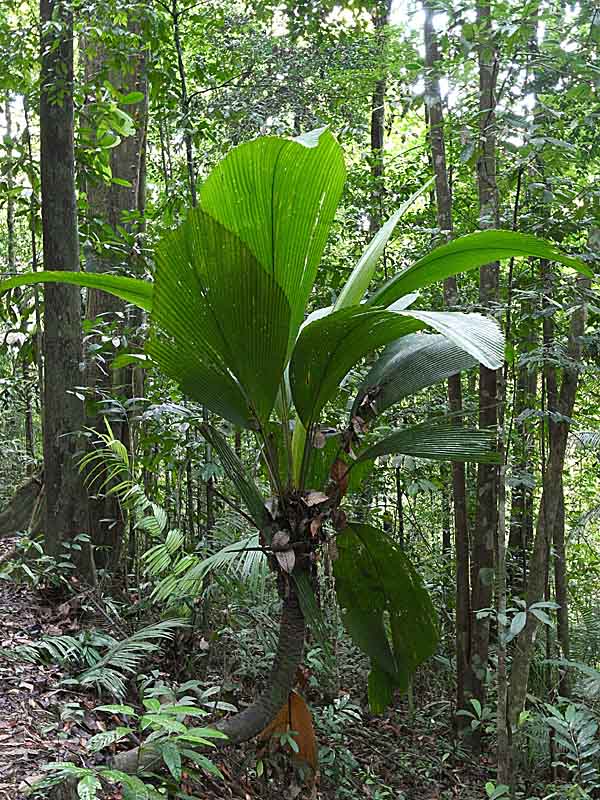
Fig 3
|
Order : CHIROPTERA
Family : Pteropodidae
Species : Cynopterus
cf. brachyotis
Forearm Length : 56-63 mm
Weight : 24-35 grams
(Francis, 2019)
The small bat shown here
was found roosting alone under a broad palm frond in lowland primary forest
in the Kledang Saiong range, north of Ipoh, Peninsular Malaysia.
Based on various criteria (white wing bones, white-edged ears, head shape
etc.) it is easily identifiable as a Cynopterus fruit bat.
The location of this bat was around 500 metres from the forest edge, in deep
shade near a stream gully; the habitat confirms this bat as a Forest
Short-nosed Fruit Bat (Cynopterus cf. brachyotis). The deep
orange-red colour of the fur on the head and neck indicate a male. Females
are more yellowish. (Francis, 2019)
Cynopterus cf. brachyotis (Forest Short-nosed Fruit Bat) is
considered to be the smaller, deep forest cousin of the widespread Cynopterus
brachyotis (Sunda Short-nosed Fruit Bat) which occurs in
disturbed habitats and which does not usually occur in mature primary
forest. It is an under-studied species, and its taxonomic relationship to
other Cynopterus bats is unclear.
This bat has been found in the forest canopy and the understorey. Its diet
comprises fruits, especially figs. (Francis, 2019)
Cynopterus cf. brachyotis occurs in southern Thailand, Peninsular Malaysia and
parts of Borneo. (Jayaraj et al, 2012).
The palm is clearly identifiable as Johannesteijsmannia perakensis
(Joey Palm, Sakai Palm), a rare species of limited distribution. This unique
palm has broad, undivided fronds, and a short trunk; it grows near stream
gullies and is restricted to the states of Perak and Kedah in northern
Peninsular Malaysia.
The male in these images appeared to make use of this roost during wetter
periods; the roost remained unused during dry periods.
Figs 1 and 2 : Male example clinging to the underside of a massive
frond of Johannesteijsmannia perakensis. The bat is around 4 metres
from the ground.
Fig 3 : A typical example of Johannesteijsmannia perakensis. This is
the only species in the genus which can grow a short trunk.
References and links :
Francis, C.M. 2019. A Field Guide to the Mammals of South-east Asia. Second
Edition. New Holland. 416 pp.
Jayaraj, V. K., Laman, C. J., & Abdullah, M. T. (2012). A predictive
model to differentiate the fruit bats Cynopterus brachyotis and C.
cf. brachyotis forest (Chiroptera: Pteropodidae) from Malaysia
using multivariate analysis. Zoological Studies, 51(2), 259-271.
Palmpedia - Johannesteijsmannia
perakensis
|