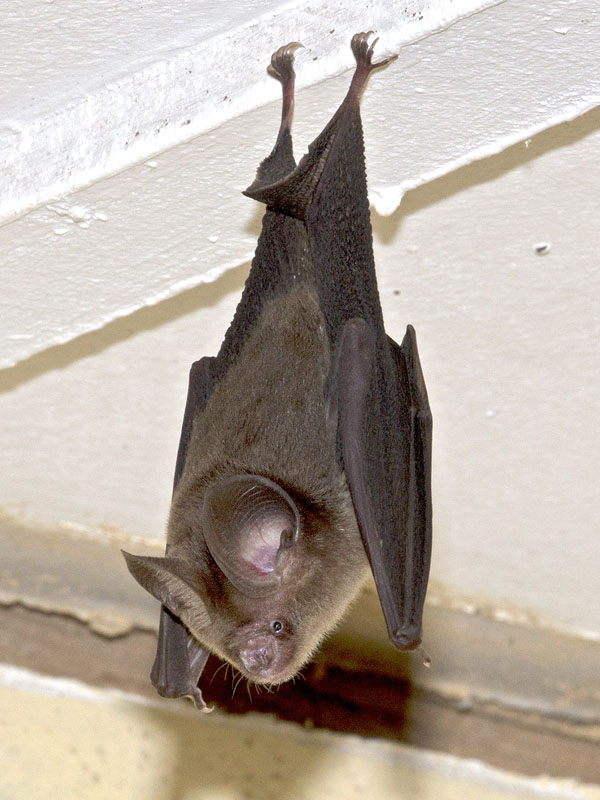
Fig 1
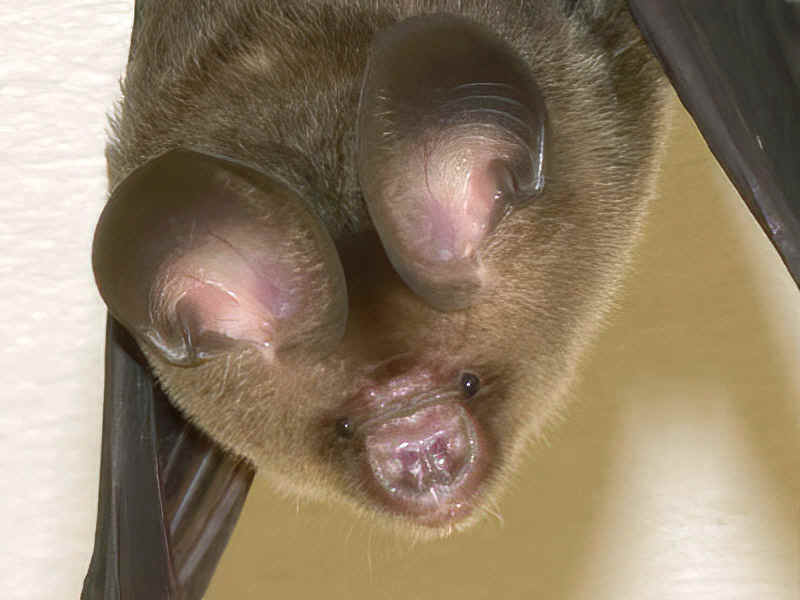
Fig 2

Fig 3
|
Order : CHIROPTERA
Family : Hipposideridae
Species : Hipposideros kunzi
Forearm Length : up to 4.8 cm ?
The bat feautured on this
page is tentatively identified as Hipposideros kunzi (Kunz's
Roundleaf Bat) based on its brownish dorsal fur, fawn ventral fur,
the shape of its internarial septum and its roosting habit. It was found
roosting by day in a vacant, abandoned chalet isolated from primary forest
by a distance of 60 metres of short grassland.
Hipposideros kunzi
is a relatively small species of Hipposideros which inhabits lowland forest.
It was first described in 2018 (Murray et al, 2018), and is known from
southern Thailand and northern Peninsular Malaysia.
The species is closely related to Hipposideros
bicolor (Bicoloured Roundleaf Bat).
The abstract for the 2018 paper is reproduced below:
"With 70 named species and multiple morphologically cryptic lineages,
the genus Hipposideros is a diverse and taxonomically contentious
group of insectivorous bats in the Old World tropics. Half of the named
species and most of the cryptic diversity in Hipposideros are
concentrated in the bicolor species group. Here we resolve the taxonomic
status of Hipposideros bicolor (Temminck, 1834), the species group's
namesake.
Two morphologically cryptic but acoustically and genetically
distinct lineages of H. bicolor co-occur in peninsular Malaysia and
Thailand. Pending taxonomic revision, these lineages were named according to
the average frequency of maximum energy of echolocation calls of populations
in central peninsular Malaysia, H. bicolor-131 and H. bicolor-142.
To determine the taxonomic status of the two lineages we measured cranial
characters from all available type specimens in the H. bicolor
species group, and collected morphometric, acoustic and mitochondrial DNA
sequence data for H. bicolor-131, H. bicolor-142, and closely
related lineages, from multiple localities on the Malay peninsula and
Borneo.
Consistent with prior studies, acoustic and genetic analyses
strongly support species status for H. bicolor-131 and H. bicolor-142.
We find subtle but significant differences in cranial characters, including
a longer skull and longer upper and lower tooth rows in H. bicolor-131
relative to H. bicolor-142. Most importantly, inclusion of cranial
measurements for type specimens in the H. bicolor species group
indicates that H. bicolor-131 should retain the species name, while H.
bicolor-142 is distinct from all previously named species. We therefore
provide a complete description for this new species of bat from Southeast
Asia, Hipposideros kunzi sp. nov."
Figs 1 and 2 : Tentative example from Sungai Relai, Pahang, Peninsular
Malaysia, found roosting in an abandoned chalet at a distance of 60 metres
from primary forest.
Fig 3 : Primary lowland forest near the
location of the bat in Figures 1 and 2.
References :
Murray, S. W., Khan, F. A., Kingston, T., Zubaid, A., & Campbell, P.
(2018). A new species in the Hipposideros bicolor group (Chiroptera:
Hipposideridae) from Peninsular Malaysia. Acta chiropterologica, 20(1),
1-29.
|