Fig 1

Fig 2
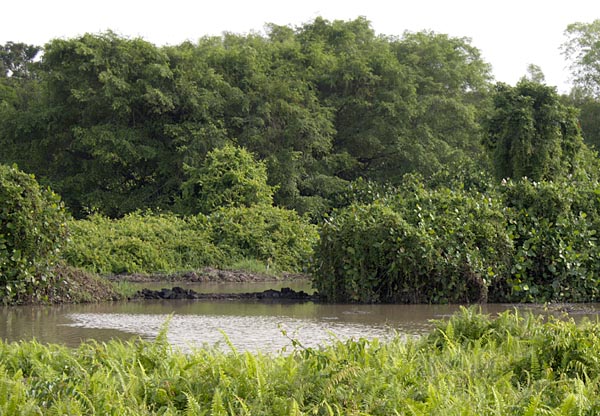
Fig 3
|
Order : Anabantiformes
Family : ANABANTIDAE
Species : Anabas testudineus
Maximum Length : 23 cm
>
Link to Fishbase
Anabas testudineus
(Asian Climbing Perch)
is an adaptable species of forest streams and open-country water bodies. It
is commonly seen resting on the substrate of shallow ponds.
Climbing perch are able to survive for some time out of water in moist
environments; at such times they gulp air which they retain in a labyrinth
organ - this is a specialised structure in the head designed to absorb
atmospheric oxygen. In temporarily waterlogged habitats, such as flooded
grassland or swamp forest, they are thus able to migrate from one water body
to another.
They 'walk' by opening the gill plates for support, and then pushing forward
with the strong pectoral, pelvic and tail fins.
In the field, this species can be identified by the thickset body and rounded head, and by
the small black markings which occur on the gill plates and at the base of
the tail. The dorsal fin is long and spiny, and the tail fin is short.
It is omnivorous, feeding on plant matter as well as small invertebrates or
fish.
Anabas testudineus is widespread, ranging from India through much of
Southeast Asia and East Asia.
Fig 1 : Resting on the substrate of a shallow,
silty, open-country pond, Singapore.
Fig 2 : Specimen in an open-country stream in
Singapore's western catchment.
Fig 3 ; Kranji Marshes, Singapore; this secondary freshwater wetland,
formed by damming of a mangrove inlet in in the 1970's, has shallow
pools at its margin in which Anabas testudineus occurs.
References :
Ho Jonathan K. I., Sorain J. Ramchunder, Andrew Memory, Meryl Theng, Li
Tianjiao, Esther Clews, Cai Yixiong, Tan Heok Hui & Darren C. J. Yeo.
(2016). A Guide to the Freshwater Fauna of Nee Soon Swamp Forest.
Singapore: Lee Kong Chian Natural History Museum & Tropical Marine
Science Institute, National University of Singapore. 139 pp.
|