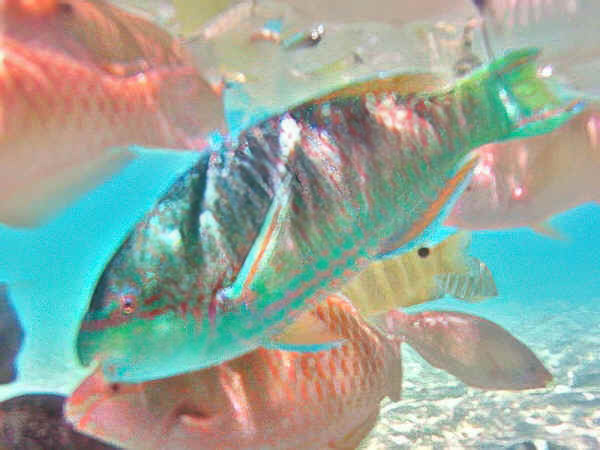
Fig 1
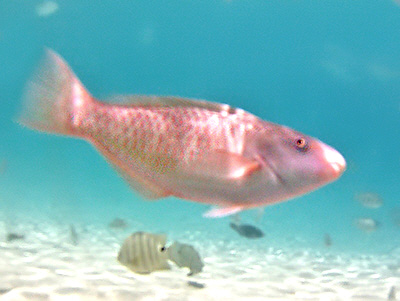
Fig 2
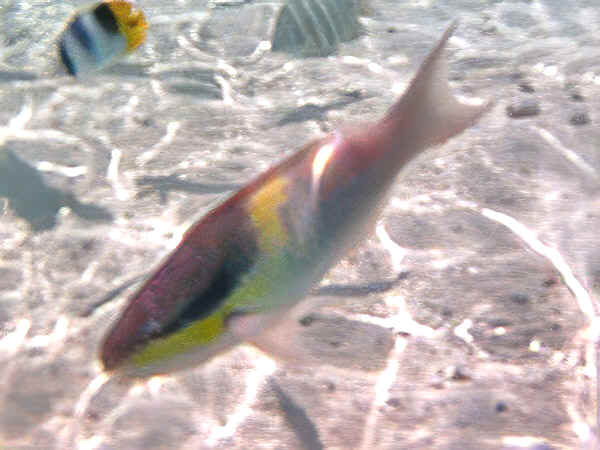
Fig 3
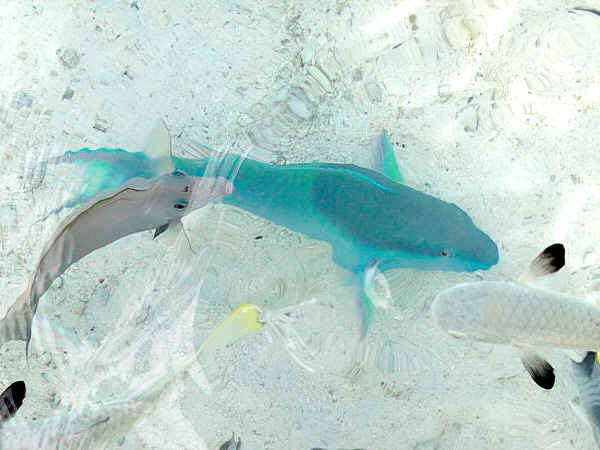
Fig 4
|
Order : Perciformes
Family : SCARIDAE
Species : As of 2025, nearly 100 species in 10 genera
Maximum Length :
more than 130 cm in Bolbometopon muricatum.
Parrotfishes are a
group of brightly coloured, reef-dwelling fishes in the family Scaridae.
Recent genetic studies have downgraded the Scaridae family to the status of a
subfamily (i.e. Scarinae), but the long-established family name is still widely
used.
As of 2025, nearly 100 species are recognised in 10 genera. The genus Scarus
is the most-speciose with more than 50 species recognised.
Parrotfishes are so-called because of their dentition; their forward
projecting teeth are tightly packed together to form a tough gnawing,
beak-like structure which resemble a parrot's bill. They are mainly coral reef
dwellers, but some species inhabit seagrass beds.
In coral reefs, and in areas of rock outrcop, their 'beak' allows them to
scrape surface marine algae for consumption. Species with tougher beaks can also gnaw away
at coral to access protein
rich organisms, such as cyanobacteria, within the coral structure.
Such activity helps to reduce algal overgrowth on coral reefs, thereby
contributing to the overall health of coral reef ecosystems. The production of
coral sand is also a significant side-effect of their feeding behaviour.
Those species that occur in seagrass beds consume a variety of marine flora.
Most species of parrotfish grow to around 30-40 cm total length. The largest
species, the Green Humphead Parrotfish (Bolbometopon muricatum), can
reach more than 130 cm.
Parrotfishes have various colour forms including a drab 'initial phase',
typically brownish, which is either female or male, and a brightly coloured
bluish or greenish 'terminal phase', which is a dominant male.
Parrotfishes reach their
greatest diversity in the Indo-Pacific region, which includes Southeast Asia
at its heart.
Fig 1 : Globehead Parrotfish Scarus
globiceps (also known as Violet-lined Parrotfish). This species occurs
in lagoons and coral reefs in many parts of Southeast Asia. It can grow up
to 45 cm total length.
Fig 2 : A bright pink Scarus parrotfish.
Figs 3 and 4 : Two examples of Dark-capped Parrotfish Scarus oviceps.
Figure 3 is the 'initial phase', which is mainly brownish, and Figure 4 is a
bright blue 'terminal phase' dominant male. This species occurs in lagoons and
coral reefs in many parts of Southeast Asia. It can grow up to 44 cm total
length.
References and links :
Fishbase
- Scaridae
Wikipedia
- Parrotfishes
|