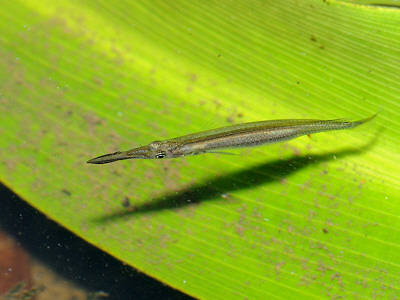
Fig 1

Fig 2
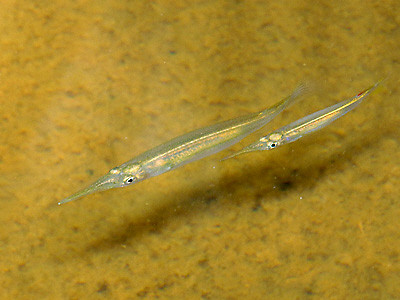
Fig 3
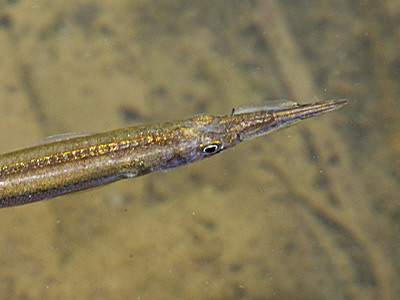
Fig 4
|
Order :
Beloniformes
Family : ZENACHOPTERIDAE
Species : Dermogenys collettei
Maximum Length : 7 cm
>
Link to Fishbase
This surface dwelling,
carnivorous fish is adapted to habitats varying from acidic, tropical forest
streams to brackish mangrove streams.
It is identified by its
small size and shape of the jaw. Males often have a red blotch on the dorsal
fin, and can be aggressive towards other males. The species
is ovoviviparous, meaning the young fry hatch internally in the female and
are then born alive.
The Pygmy Halfbeak can be
distinguished from the similar Forest Halfbeak
Hemirhamphodon pogonognathus by the position of the dorsal fin which
begins behind the anal fin.
The species occurs in many
Southeast Asian countries including Thailand, Malaysia, Singapore and
Indonesia.
Fig 1 : A 4cm specimen amongst pondside vegetation in a shallow, silty,
open-country pond, Singapore.
Fig 2 : Stream gully in Singapore's central forest; Dermogenys collettei
occurs in such habitat.
Fig 3 : A female (6 cm), presumably in breeding condition, is closely followed
by a smaller male (3 cm). Seen in a shallow, secondary forest stream,
Singapore.
Fig 4 : Specimen in a brackish stream inlet, Pulau Sugi, Riau Archipelago,
Indonesia.
References :
Ho Jonathan K. I., Sorain J. Ramchunder, Andrew Memory, Meryl Theng, Li
Tianjiao, Esther Clews, Cai Yixiong, Tan Heok Hui & Darren C. J. Yeo.
(2016). A Guide to the Freshwater Fauna of Nee Soon Swamp Forest.
Singapore: Lee Kong Chian Natural History Museum & Tropical Marine
Science Institute, National University of Singapore. 139 pp.
|