 |
Family : LACERTIDAE
Species : Takydromus sexlineatus
Size (snout to vent) : 6.5 cm
Size (total length) : ~ 50 cm
Takydromus sexlineatus
(Asian Grass Lizard, Six-lined Long-tailed Grass Lizard) is adapted for open, grassy
habitats, marshes and disturbed habitats including areas dominated by low shrubs.
It is diurnal and mainly arboreal.
Members of the genus Takydromus, of which 4 species occur in
Southeast Asia, are easily identified by their extremely long tails. In the
case of Takydromus sexlineatus the tail may exceed 6 times the
head-body length (see image in Tay, 2016). This oversized appendage is used
to distribute body weight on tall grass and other vegetation.
In rural areas this lizard may be glimpsed as it quickly runs across the
road to move from one patch of roadside grassland to another.
It has a number of pale stripes extending along its elongate body and onto the tail: this patterning serves as excellent camouflage in long grass.
Its dorsum, flanks and top of the head are brown, and the underside of its
head and body is green (sometimes bluish-green, sometimes yellowish). There
may be pale spots along the flanks.
Insects and other small invertebrates, such as
millipedes, make up its diet (Das, 2010).
This is a widespread species, and is known to occur in northeast
India, Bangladesh, southern China and many countries of Southeast Asia
including Myanmar, Thailand, Vietnam, Cambodia, Laos and Indonesia (Sumatra,
Riau Islands, Natuna Islands, Borneo, Java and Bali).
In Peninsular Malaysia it appears to only occur in the northwest, with
records from the states of Penang and Kedah (Grismer, 2011). There is a curious absence in
central and southern Peninsular Malaysia and Singapore, despite the presence of apparently
suitable habitat. Immediately to the south of Singapore it is, however, recorded from Bintan Island, Riau Province, Indonesia (Tay, 2016).
There are no records, either historic or recent, from the Philippines
(Emerson Sy, pers. comm.).
Reptile Database
lists 3 other species of Takydromus for Southeast Asia - T.
hani, T. kuehni and T. madaensis which all occur in Vietnam.
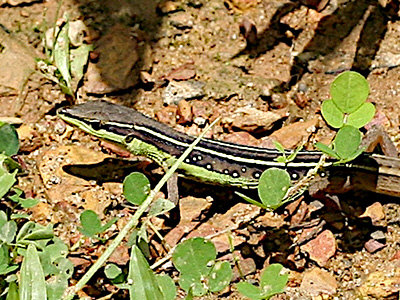
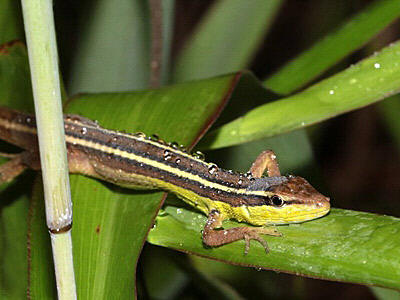
Figs 1 and 2 : Example from Cat Tien National Park, Vietnam, seen in secondary
growth at the edge
of a forested road. Based on the location, this is the subspecies T.
s. ocellatus (Das, 2010). Note the pale spots on the flanks. Photo thanks to Derek Clark.
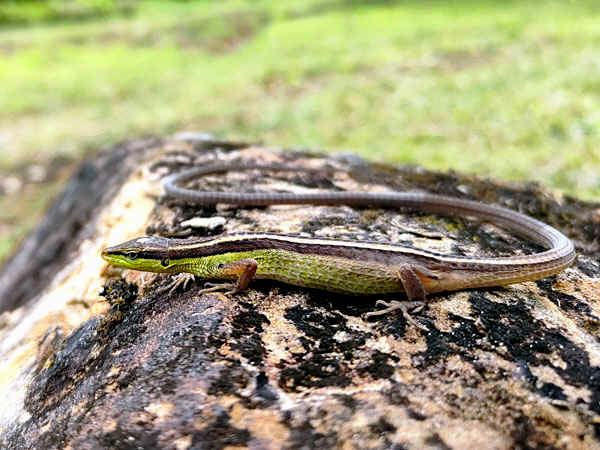
Fig 3 : Example from Sarawak, Borneo, found resting in long grass at
night. Based on the location, this is the subspecies T. s.
sexlineatus (Das, 2010). Photo thanks to Noel Thomas.
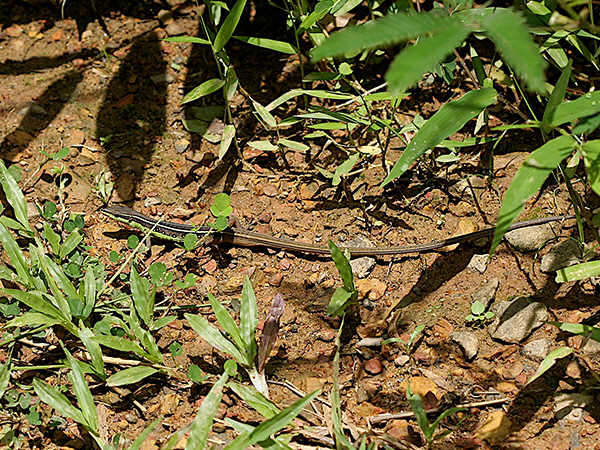
Fig 4 : Example T. s.
sexlineatus sunning itself on a rock at the edge of managed grassland in
Sarawak, Malaysian Borneo. Photo thanks to Sankar Ananthanarayanan.
References :
Das, I., 2010. A Field Guide to the Reptiles of South-east Asia. New
Holland Publishers (UK) Ltd.
Grismer, L. L. (2011). Lizards of Peninsular Malaysia, Singapore, and
their Adjacent Archipelagos. Their Description, Distribution, and
Natural History. Edition Chimaira, Frankfurt am Main. 728 pp.
Tay, A. (2016). Southeast Asia Vertebrate Records. 2016:31-32. [pdf]
|