Fig 1
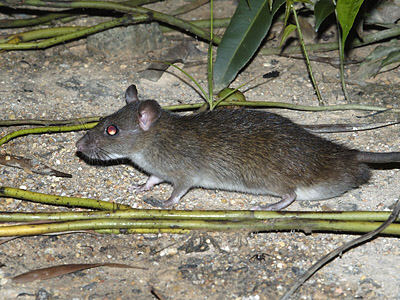
Fig 2
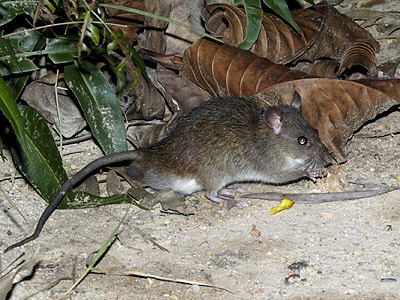
Fig 3
|
Order : RODENTIA
Family : Muridae
Species : Rattus tiomanicus
Head-Body Length : 14-19 cm
Tail Length : 15-20 cm
Weight : 55-150 grams
Source : Francis (2019)
Rattus tiomanicus
(Malaysian Wood Rat, Malayan Field Rat) is a widespread rodent which occurs
in in a variety of habitats including secondary forest, primary forest edge,
coastal forest (including back mangrove?) and grassland. It has also
adapted to rubber and palm oil plantations, and is known to consume the
fallen fruits of oil palm.
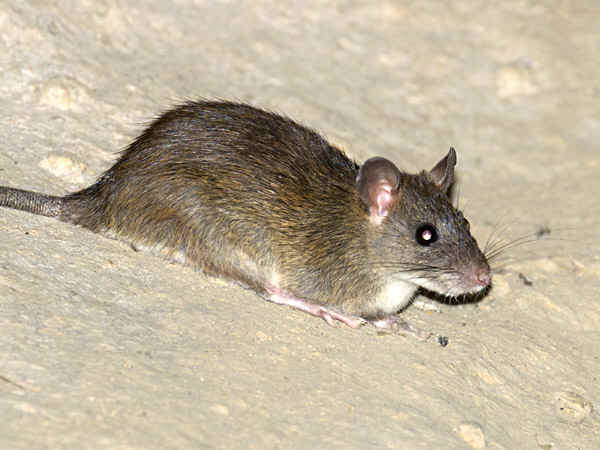
The example in Figure 1 was encountered inside a limestone cave in
Peninsular Malaysia.
It is mainly nocturnal in habits, and is non-commensal i.e. it rarely
inhabits buildings or survives in urban settings. It can climb well but is
equally adapted to life on the ground.
Its upperparts are olive-brown,
and its underside is light grey to white, the latter being an identifying
feature. The head and lower flanks are greyish. Its fur is smooth, and its
'guard hairs' are black and relatively short. Its tail is dark and virtually
hairless. Its ears are relatively large. Its feet are pink, broad
and the upper side is largely devoid of hair. Its foodpads are ridged.
The presence of this prey species in Southeast Asia's vast oil palm
plantations may help to support populations of the Mainland
Leopard Cat (Prionailurus bengalensis).
Rattus tiomanicus occurs in southern Thailand, Peninsular Malaysia including the island of Tioman
(after which the species
is named), Singapore, Sumatra, Java, Bali, Borneo and parts of the Palawan
Faunal Region in the Philippines (Aplin, 2016).
This species has been recorded at 1650 metres on Mount Kinabalu, Sabah,
Borneo (Phillipps & Phillipps, 2016).
Fig 1 : Rattus tiomanicus encountered by day inside a limestone cave at
Gunung Lang, Ipoh, Peninsular Malaysia.
Figs 2 and 3 : This example was seen at night in sparse, secondary scrub, in
the west of Singapore.
References :
Aplin, K. 2016. Rattus tiomanicus. The IUCN Red List of Threatened Species 2016:
e.T19368A22445426.
Francis, C.M. 2019. A Field Guide to the Mammals of South-east Asia. Second
Edition. New Holland. 416 pp.
Phillipps Q. & Phillipps K. (2016). Phillipps’ Field Guide to the
Mammals of Borneo and Their Ecology: Sabah, Sarawak, Brunei, and
Kalimantan. Second Edition. John Beaufoy Publishing. 400 pp.
|