 |
Family : COLUBRIDAE
Species : Calamaria bicolor
Maximum Size : 45 cm
Calamaria bicolor
(Bicoloured Reed Snake, Two-coloured Dwarf Snake) occurs on the islands of
Java and Borneo.
As with other species of the genus
Calamaria, this snake is terrestrial and fossorial in habits, and is typically
only encountered at night on the forest floor or amongst leaf litter.
In cross-section the body is cylindrical, and the head is of the same width
as the body, which allows for easy burrowing. The tail is short.
Adults are described as "Dorsum blue black or dark brown, unpatterned
or with dark cross-bands; forehead dark brown, sometimes with 2 oblique dark
bands crossing yellow labials; venter typically unpatterned yellow or
spotted with black." (Das, 2010).
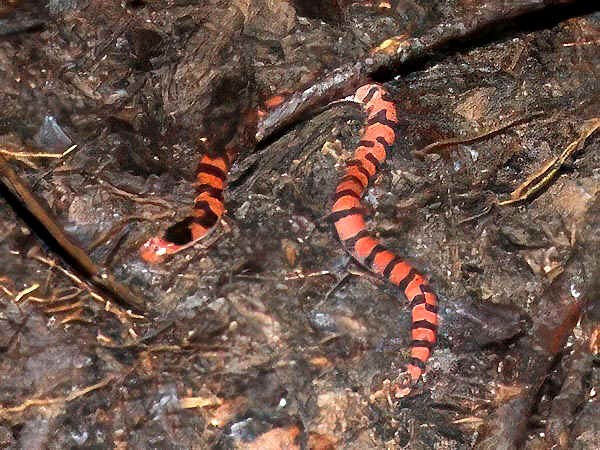
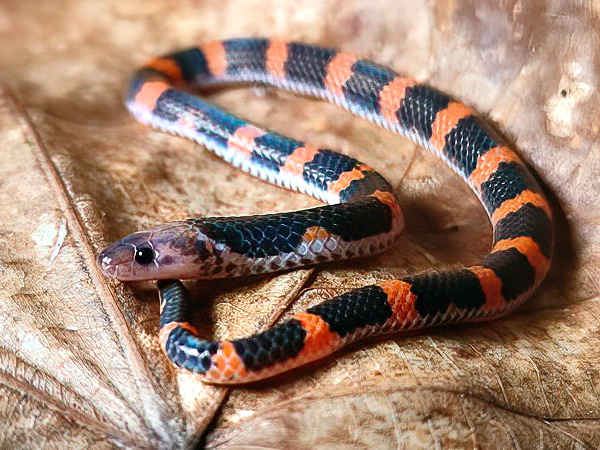
Juveniles, of which two examples are shown here, are less-often described in available literature, but these are
typified by the presence of orange-red bands across the dark dorsum. In smaller
juveniles these
bands appear to be broader than the intervening dark bands, whilst in larger
juveniles they may be narrower than the dark bands.
Reed snakes typically feed on soft-bodied invertebrates.
Fig 1 : Juvenile example from the highlands region of Sarawak, Malaysian
Borneo at around 1000 metres elevation. Photo thanks to Sankar Ananthanarayanan.
Fig 2 : The bright colour and patterning of this small juvenile Calamaria
bicolor made it easy to spot on the forest floor. It
was found in an area of lowland forest (elevation = 300 metres) in North
Kalimantan, Indonesian Borneo. It had an estimated total length of 13-15
cm. Photo
thanks to William Bruce.
Fig 3 : Forest and stream habitat close to the location of the juvenile
snake in Figure 2. Photo
thanks to William Bruce.
References and links :
Das, I., 2010. A Field Guide to the Reptiles of South-east Asia. New Holland
Publishers (UK) Ltd.
Reptile
Database - Calamaria bicolor
|