 |
Family : ELAPIDAE (Hydrophiinae)
Species : Hydrophis curtus (Lapemis curtus)
Maximum Size : 97 cm
Hydrophis curtus (Short Sea Snake,
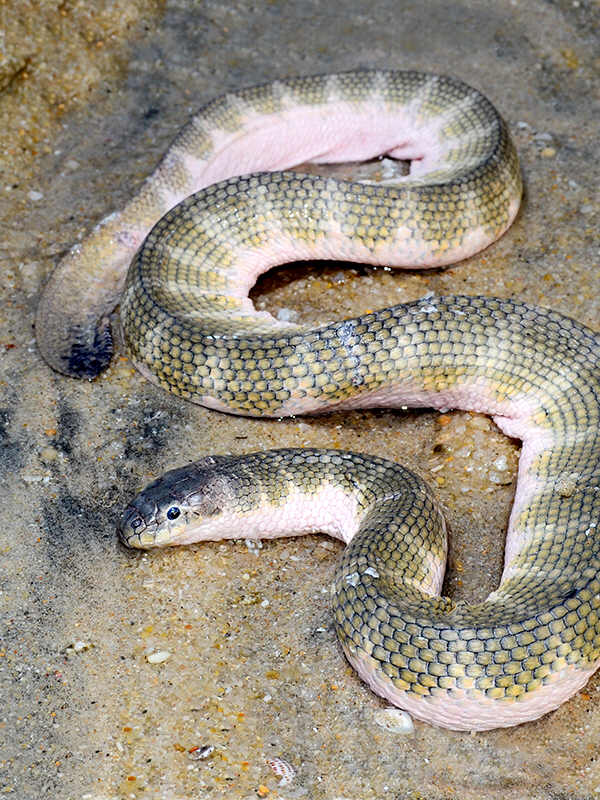
Spine-bellied Sea Snake, Shaw's Sea Snake) has a thick, robust body shape,
and its short head is barely wider than its body. Its tail is short and
highly compressed, and its ventral skin is loose and baggy.
Its dorsal scales are yellowish or olive on the flanks, becoming dark grey
along the top of the body, and the lower flanks are cream or pinkish. Pale
banding is present in juveniles, however this patterning is less visible in
large adults.
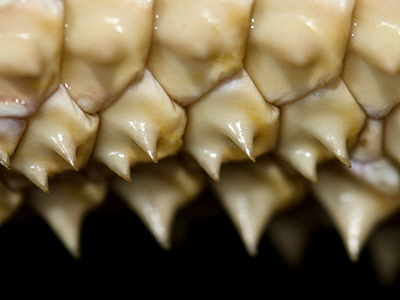
The lower scale rows of males have paired, spiny projections (see Fig 2),
which probably help to secure a couple whilst mating.
As with nearly all sea snakes, this species is viviparous i.e. eggs are
not laid, but instead the young are born directly into an aquatic habitat.
A study from the western coast of India (Lobo et al, 2005) confirmed
that this snake is a generalist feeder, preying on fishes from different
depths of the marine environment.
This widespread snake is recorded in shallow seas at the margins of
continental Southeast Asia. Its broader range extends from the Persian Gulf
and the Indian Ocean through Southeast Asia to the western Pacific Ocean.
Fig 1 :
Example from the Straits of Malacca, caught as by-catch by fishermen
operating from Pulau Pinang, Peninsular Malaysia. Photo thanks to Luke Allen.
Fig 2 : Close up of the lower scale rows of a male Hydrophis curtus
showing paired spiny projections. Photo thanks to Luke Allen.
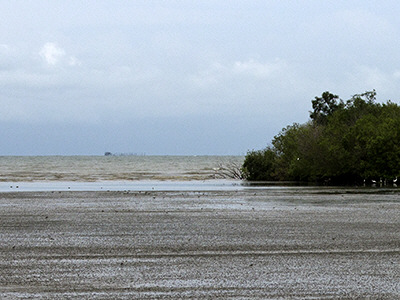
Fig 3 : The murky, silt-laden waters of the Straits of Malacca recede at
low tide, revealing extensive coastal mudflats fringed by mangrove, near the fishing village
of Parit Jawa, Johor, Peninsular Malaysia. These narrow straits lie in
the heart of the range of Hydrophis curtus.
References :
Lobo, A. S., Vasudevan, K. & Pandav, B. (2005). Trophic ecology of
Lapemis curtus (Hydrophiinae) along the western coast of India.
Copeia, 2005(3), 637-641
Links :
Reptile Database |