Fig 1
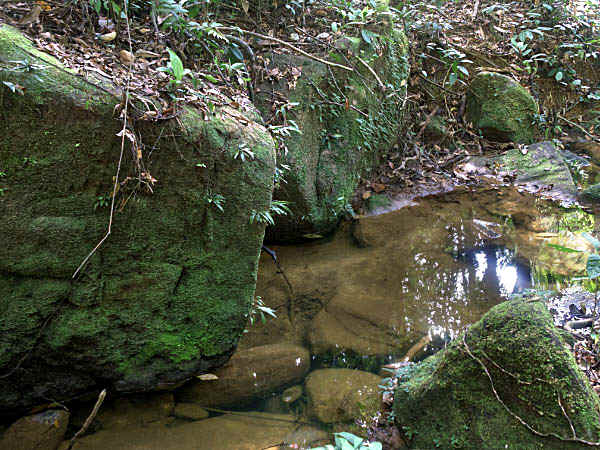
Fig 2

Fig 3
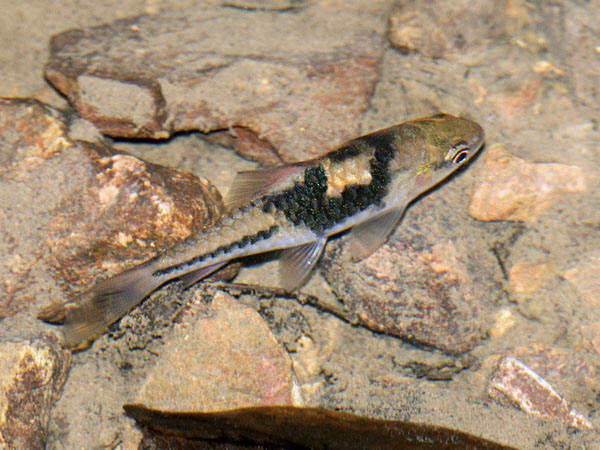
Fig 4
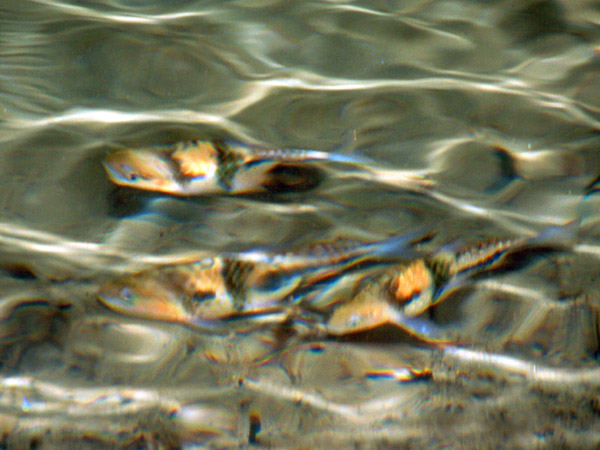
Fig 5

Fig 6

Fig 7
|
Order : Cypriniformes
Family : CYPRINIDAE
Species : Striuntius lateristriga
Maximum Length : 20 cm
(Ho et al, 2016)
>
Link to Fishbase
Striuntius lateristriga
(Spanner Barb, T-Barb), formerly Barbodes lateristriga, is easily
identified by its silvery-yellowish body, two thick vertical bars and typically a single, broken
horizontal band on the flanks. The intensity of this patterning can vary with different
populations. The black bar below the dorsal fin may thicken with age, eventually
becoming a large blotch.
This gregarious species inhabits deeper pools in clear, forest
streams, venturing into shallow water to feed on insects, worms and plant
matter. Mixed shoals with other species are sometimes seen.
If disturbed they seek cover amongst boulders or submerged forest debris.
Presented here are examples from many different locations in the Malay
Peninsula.
Spanner barbs occur
in Thailand, Peninsular Malaysia, Singapore,
Sumatra, Java and parts of western Borneo.
Fig 1 : Example from a fast-flowing, clear rocky stream at Ulu Chepor, Perak, Peninsular Malaysia.
Fig 2 : Stream in the lowlands of Peninsular Malaysia, with huge
moss-covered boulders. This is a prime habitat for Striuntius
lateristriga, where there are dark crevices for them to take refuge.
Fig 3 : This example was found in a side stream, at the base of Boripatra
waterfall, Songkhla province, southern Thailand.
Fig 4 : Example from Sungai Yu, Pahang, Peninsular Malaysia.
Fig 5 : Part of a shoal in a fast-flowing, rocky stream on Tioman Island,
Peninsular Malaysia.
Fig 6 : This individual was seen in a shaded forest stream, with sandy
substrate at Gunung Pulai, Johor,
Peninsular Malaysia.
Fig 7 : Atypical, pale variant in a shallow forest stream in Singapore.
References :
Ho Jonathan K. I., Sorain J. Ramchunder, Andrew Memory, Meryl Theng, Li
Tianjiao, Esther Clews, Cai Yixiong, Tan Heok Hui & Darren C. J. Yeo. (2016). A
Guide to the Freshwater Fauna of Nee Soon Swamp
Forest. Singapore: Lee Kong Chian Natural History Museum & Tropical Marine
Science Institute, National University of Singapore. 139 pp.
|